
Our Water Quality Ranges: Evidence and Adjustments

Water quality is one of the ways through which we try to improve welfare in our farm program in India, the Alliance for Responsible Aquaculture (ARA). In this program, farmers commit to maintaining water quality we believe is appropriate for fish welfare, supported by water quality measurements and tailored corrective actions from FWI staff.
It is important that the ranges we ask farmers to maintain are grounded in the best evidence we have. Recently, we revisited that evidence through a literature review for Indian major carp. That review led us to make a few minor adjustments to our ARA ranges, which are described further below.
Water Quality: The Foundation of Our Farm Program
Many semi-intensive farms in our programming regions do not have access to regular water quality analysis services and may experience periods of severe oxygen depletion, inappropriate pH, or toxic ammonia buildup. Without corrective action, these conditions can cause severe stress for fishes and, in some cases, death.
To help farmers maintain better conditions, the ARA provides free water quality monitoring to farms in rural India. We measure dissolved oxygen, pH, ammonia, and temperature to determine whether key parameters fall outside our required ranges.
We use both required and ideal ranges. Required ranges are the thresholds we currently operationalize in the ARA, while ideal ranges act as additional guidance for farmers who are willing and able to go beyond the required ranges.
Previous ARA Water Quality Ranges
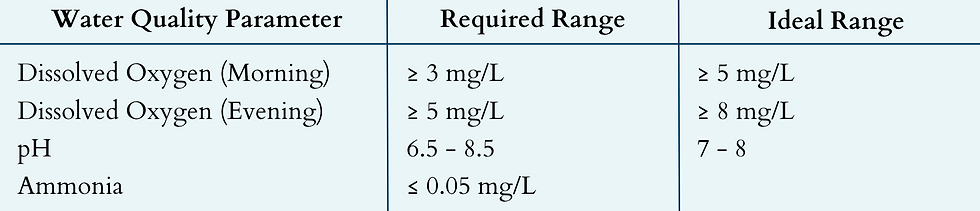
How We Operationalize Water Quality Ranges
If water quality at a farm falls outside the required range, we notify the farmer immediately and require corrective action. We then follow up until the water quality returns to safer levels.
Some severe instances of poor water quality, where our support helped farmers improve conditions, are eligible to be counted toward our impact and are assessed using our impact thresholds.

Reviewing the Evidence Behind Our Thresholds
We first developed our water quality ranges for Indian major carp in 2021, when we founded the ARA. These ranges were based on a literature review and field observations by our Fish Welfare Specialists, Dr. Marco Cerqueira and Vivek Rachuri.
At the time, we did not document that work as thoroughly as we would today. Improving on that and incorporating studies published since 2021, we recently completed a comprehensive literature review on appropriate water quality ranges for Indian major carp:
Adjustments to Our ARA Ranges
After considering newly published papers that were not available when we first created these ranges in 2021, the review suggested a few minor adjustments to our ARA ranges.
We do not expect these changes to meaningfully affect the frequency of out-of-range measurements or the number of estimated fishes helped. This is mainly because the dissolved oxygen upper bounds were not a major issue on these farms.

Dissolved Oxygen: Why We Removed Upper Bounds
The morning reading captures the overnight low, which is often the most important reading of the day. Because dissolved oxygen (DO) below 3 mg/L can seriously harm Indian major carps, we kept ≥ 3 mg/L as the morning minimum.
We removed the old upper bound because there is no evidence suggesting that higher DO levels are harmful for Indian major carp. Aside from removing the upper bounds, we lowered the evening minimum from 8 to 5 mg/L, because the evidence suggests welfare concerns begin below 5 mg/L, not 8 mg/L.
Ammonia: Required Range Confirmed, Ideal Range Added
We kept the required ammonia range at ≤ 0.05 mg/L NH₃. This remains the point above which risk becomes more serious for Indian major carps.
We also added a new ideal range of ≤ 0.02 mg/L NH₃. We do not currently use this as a required ARA threshold, but it gives farmers a useful target when consistently good water quality is possible.
Keeping Our Evidence Updated
We plan to revisit this literature review every two years so that we can incorporate new publications and data.
This review brings us closer to a stronger evidence base for the ARA. Another remaining question is whether the water quality improvements we observe would have happened without our involvement. To help answer that, we are currently running a randomized controlled trial to evaluate our outcomes. We expect to share results from that evaluation by July.


