
Improved Slaughter: What Our “Chill Kill” Trials Taught Us So Far

Summary
For nearly a year now, we have been running trials of “chill kill”, a method of slaughtering fishes by submerging them in a near-freezing ice slurry. This post shares what we have learned so far in the process.
Since our initial small-scale trial in September 2025, we have conducted eight more trials, progressively scaling up to 525 fishes during a live commercial harvest. Across all trials, chill kill has consistently reduced the time fishes take to lose consciousness compared to asphyxiation, though by varying amounts. We have also sent chill-killed fishes to market twice: the first buyers responded positively but noted some discoloration, and the second set noticed no difference from conventionally slaughtered fishes.
We are encouraged by this progress, but significant questions remain:
Market acceptance: Whether buyers will consistently accept chill-killed fishes remains an open question.
Scalability: It's still unproven whether the method can work at full commercial scale.
Consciousness reversal: In our one dedicated test, a quarter of the fishes we monitored regained some level of consciousness after coming out of the tank. Whether a longer immersion time fixes that is still open.
Subjective experience: We still don't know what fishes actually experience during the process.
We are now over halfway through Q3 2026 and focusing on the first two questions, as well as some additional checks on consciousness reversal. We expect the deeper welfare questions to come later, once we are more confident in the implementability of this intervention.
Context
Virtually all farmed fishes in India are slaughtered by being pulled from the water and left to suffocate in the open air during the “harvest”. Based on our observations, this process of suffocation can take anywhere from 30 minutes to two hours. We cannot confirm the point of death, so throughout this post we judge loss of consciousness by three criteria together: no response to a tail grab, no eye movement, and no gill movement.
Chill kill is an alternative where fishes are submerged in a near-freezing ice slurry, which appears to cause them to lose consciousness significantly faster. Our tanks currently use a 1:1 ratio of ice to water. This chills the water well below ambient temperature.
Chill kill is not stunning. Fishes likely still experience a period of suffering. But it may be the most feasible improvement we can make in India’s current aquaculture context, where the infrastructure and market demand for electrical or mechanical stunning do not yet exist. For the full backstory on how we arrived at chill kill, see our project launch, phase 2 update, and initial trial posts.
All of our trials have been with rohu, one of the most widely farmed fishes in India. In September 2025, we ran our first small-scale trial: 3 fishes chill-killed vs 3 asphyxiated. Chill-killed fishes stopped responding after an average of 16 minutes, compared with 51 minutes for the fishes left in the air. That result was encouraging, but it left two open questions: Is chill kill implementable at scale? And does it constitute a sufficient welfare improvement? There were too many unknowns to answer either in a single jump.
So over the following ten months we ran eight more trials, scaling up gradually and only moving forward when the previous results warranted it. Across these trials, chill kill has typically cut the time by around three times, though the gap has varied and in one trial was under two.
Before our June 17 trial, we developed a protocol for running chill kill during a commercial harvest of a two-acre pond, fixing the immersion time at 20 minutes. No fish in our trials up to that point had shown signs of consciousness beyond 20 minutes.
The table below summarizes all nine trials. Trials 7 and 9 had no control group, as both were aimed at operational feasibility and market reception rather than re-running the welfare comparison the earlier trials had already covered. We discuss what we learned in the sections that follow.
# | Date and Link | # of Treatment Fishes | # of Control Fishes | Selected Findings of Trial |
1 | 3 | 3 | Initial testing. Key finding was that chill kill does actually appear to speed up loss of consciousness, and that we could keep ice cold in the Indian heat. | |
2 | 12 | 3 | Further evidence supporting chill kill. Weather was cloudy and colder (24°C) this day, so control fishes took a long time to stop showing signs of consciousness in the air (100+ minutes). | |
3 | 24 | 3 | No new findings, but showed that we could continue scaling. | |
4 | 48 | 3 | No new findings, but showed that we could continue scaling. | |
5 | 96 | 4 | Continued our scaling up. Time to loss of consciousness was less than 2x this time, though before it had been 3x+. | |
6 | 3 | 0 | Clearwater trial where we observed how fishes behaved during chill kill. Worth watching the video. Suggests that the fishes are still suffering significantly during chill kill, and shows the limits of not having a true ice slurry. | |
7 | 525 | 0 |
| |
8 | 50 | 50 |
| |
9 | 261 | 0 |
|

What We Learned
Time to unconsciousness, and whether it holds: Across all trials, chill kill has consistently reduced the time to loss of consciousness compared to air asphyxiation. Our 20-minute immersion time is the point by which we stopped finding signs of consciousness, not a measured average, and the true time is likely shorter.
Once we had the two-acre protocol, we ran three trials against it. June 17 and July 16 were harvest trials aimed at implementation feasibility and market reception, with consciousness assessments done alongside. June 19 was a controlled trial built to answer the recovery question directly.
In our June 17 trial with 525 fishes, we randomly selected and assessed 50 of them at the 20-minute mark, and none showed any signs of consciousness. In our July 16 trial with 261 fishes, 24 of the 25 fishes we assessed showed no behavioral response more than 20 minutes after immersion, while one showed a slow tail reflex.
Our June 19 trial is the one that gives us pause. It was the only trial we designed specifically to test whether fishes regain consciousness, and of a 20-fish subset we monitored after removing them from the tank, 5 showed signs of regaining some level of consciousness 10 to 20 minutes later.
Taken together, 20 minutes appears to be enough to make fishes unresponsive, but not reliably enough to keep them that way. We think a longer immersion time is the fix, though our trials this quarter only check this lightly.

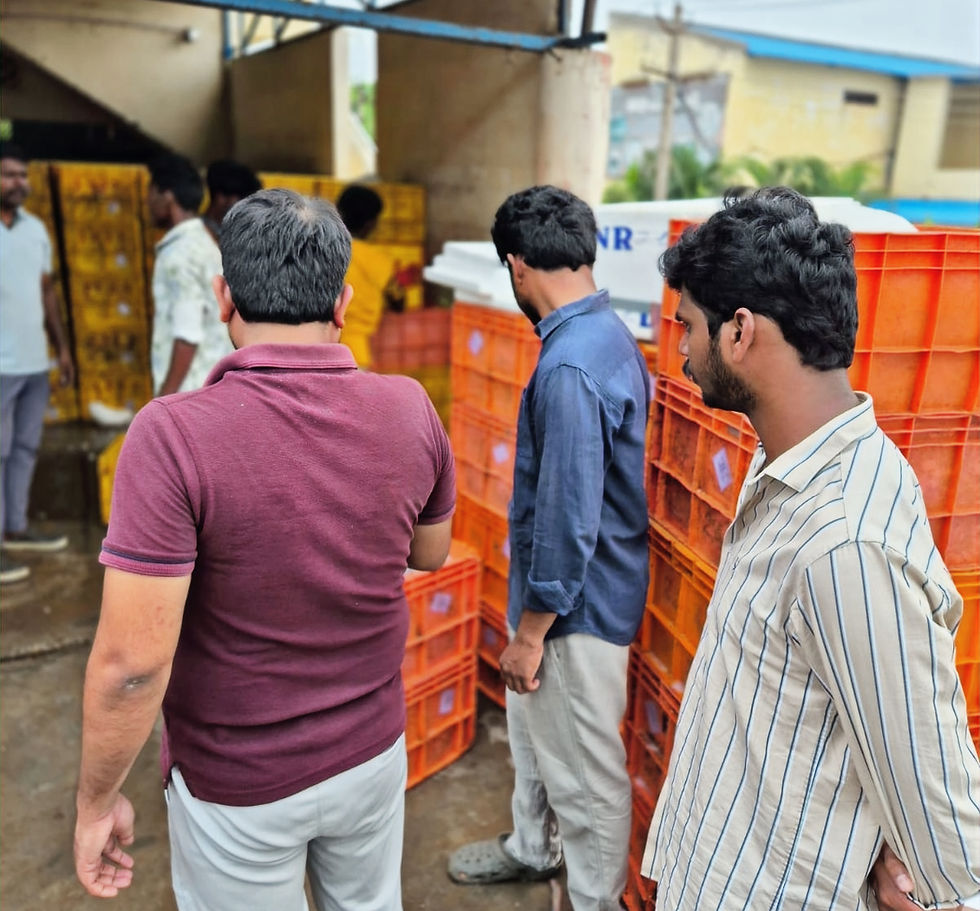
Logistics: Our June 17 trial was the first where we attempted to integrate chill kill into the harvest workflow at a meaningful scale, and it showed us the gaps between controlled trials and a routine harvest. The space near the pond where we planned to place our chill kill tanks was limited, which forced us to deploy only one of our two tanks and reduced the trial from 1,000 fishes to 525. We also received limited support from harvest workers who had their own workflow to manage.
Market Reception: The fishes from our June 17 trial were packed separately and sent to the Mumbai market, where buyers responded positively about the quality but noted some discoloration. More recently, we sent 261 chill-killed fishes to the Bihar market. Unfortunately, buyers there did not report any difference between chill-killed fishes and conventionally slaughtered fishes. They did not flag any problems, but they did not note any advantages either. These are only two data points across two markets, and we want to test more before drawing conclusions. Still, the pattern points at a real problem for adoption. Nothing so far has disqualified chill-killed fishes at market, but nothing has made them more attractive either. If traders and farmers are going to take on the extra effort and time that chill kill requires, they need a visible advantage rather than parity.
What’s Next
We are in the third quarter of this year (July to September), and this work is already underway:
Testing market acceptance: Our July 16 trial was the first of these. We plan to run further field trials of 500+ fishes, sending chill-killed fishes to market again and collecting more structured feedback on buyer reception.
Exploring automation: Our June 17 trial made clear that the current setup is too labor-intensive to work at full harvest scale. We have started conversations with vendors of freshwater ice slurry machines and fish vacuum pumps. Over the rest of the quarter, we will continue assessing equipment and scale-up options to better understand what will be needed to make chill kill viable for larger harvests.
Checking consciousness: Our focus this quarter is market reception and implementability, but we will also run light-touch checks on whether fishes regain consciousness, randomly selecting and assessing fishes during these trials.
By the end of September, based on what these trials and this research tell us, we plan to make a go/no-go decision on whether to proceed with the chill kill project. As with every phase of this work, we are prepared to stop if the evidence does not support continuing.
Remaining Uncertainties
The following are our remaining uncertainties:
Market Acceptance of Chill-Killed Fishes: Buyer reactions so far have ranged from positive to indifferent, and we do not know whether either holds across different buyers, markets, and conditions. And even if buyers do consistently accept the product, a separate question remains: is there enough of a commercial incentive for traders and farmers to take on the additional effort and cost? We plan to investigate that once we have more market data to work with.
Scalability: The June 17 trial showed the protocol can work during a harvest, but only at a fraction of the harvest volume and with considerable effort. Scaling to full harvest will require simpler equipment, automation, and stronger buy-in from farmers and workers, which we don’t have yet. We are beginning to explore these questions this quarter, but we do not yet know whether chill kill can be made simple and cheap enough for a normal harvest.
Whether fishes stay unconscious: Our June 19 recovery trial found that 5 of 20 fishes regained some level of consciousness 10 to 20 minutes after being removed from the tank, and one fish in the July 16 trial showed a slow tail reflex more than 20 minutes after immersion. We think a longer immersion time is the likely fix, but we have not confirmed that. Our trials this quarter include light-touch checks on this, but we do not expect to resolve it before the September decision.
Subjective experience of the fishes: While our trials show that fishes lose consciousness faster under chill kill, we do not yet fully understand what they experience during the process. A clearwater observation trial on March 21, where we watched fishes in clear water rather than an opaque ice slurry, suggested that fishes still suffer during chill kill. However, we believe chill kill likely reduces the duration of suffering compared to asphyxiation, but we are not claiming it eliminates suffering.
A Note on Ethics
All trials we mentioned in this post were conducted during existing commercial harvests. These fishes would have been killed via air asphyxiation regardless of our involvement. We recognize that some readers, particularly those in the animal advocacy community, may find it uncomfortable that a fish welfare organization is conducting slaughter trials. We share that discomfort. We do not take the killing of these fishes lightly, but we believe that developing a less painful alternative to asphyxiation is worth the difficult tradeoff involved.


